
Members Area

HomeMembers Area

MEMBERS AREA

Workcamp Report – Creating Glideways

Creating Glideways – a volunteer camp.

Conservation, Community and Adventure in Rural NSW

What do Greater Gliders, wombats, international friendships, tree planting, fireside conversations and wildlife surveys have in common?   They were all part of the unforgettable experience of the Creating Glideways camp, held near Taralga, New South Wales in May this year.

Over two weeks, volunteers from various parts of Australia as well as Spain, Russia, Hong Kong and France, came together to learn about conservation, contribute to habitat restoration, and experience life in a rural Australian landscape rich with wildlife and community spirit.

Volunteers were immersed in a unique blend of environmental learning and hands-on action. Guided by ecologists, conservation practitioners and local landholders, participants explored the challenges facing Australia’s native wildlife and discovered how ordinary people can make a difference.

The Greater Glider is under threat due to fragmentation of habitat. They depend on connected forests, high canopy and hollow-bearing trees for survival.

Volunteers received practical training in wildlife monitoring techniques, including camera trapping, Elliot traps, using binoculars, habitat assessments and small mammal surveys. They learned how scientists study biodiversity and how conservation decisions are made on the ground.

Sonia, from Spain, and Ecologist Anne Kerle. Setting Elliot traps. 

The wildlife encounters alone made the experience unforgettable. During the first few days, participants were thrilled to spot kangaroos, wallabies, wombats, colourful birdlife and an echidna. 

A lecture and slide show on Greater Gliders prepared them for the next days of activity.  Night-time spotlighting adventures became a favourite activity, with volunteers wrapping themselves in multiple layers before heading into the forest to search for Greater Gliders. A healthy population of Greater Gliders was discovered in several locations.  Seeing these remarkable nocturnal animals in the canopy was a powerful reminder of why habitat conservation matters.  

Dylan from France setting up a camera trap.

Volunteers planted trees to strengthen future wildlife corridors, assisted with habitat surveys, and worked alongside experts to install specialised nest boxes designed to provide shelter for Greater Gliders and other hollow-dependent species. Cameras were erected on high poles to catch activity at the nest boxes.  Every task contributed to a larger vision of reconnecting habitats across the landscape.

Night time activity. Can you see the long tail? 

Beyond the conservation work, volunteers had opportunities to experience local community life. A visit to the Goulburn Farmers Market introduced participants to local producers and community initiatives, while a tour of the Goulburn Community Solar Farm showcased another inspiring example of grassroots environmental action. A trip to the spectacular Wombeyan Caves provided a well-earned break and the chance to explore one of the region’s natural treasures.

Setting up specially designed nest boxes and cameras in the high canopy.

Perhaps the most rewarding part of the workcamp was the people. Volunteers from different countries and backgrounds lived, cooked, learned and worked together for two weeks. Meals became opportunities to share cultures, stories and ideas. Evenings around the fire sparked conversations about environmental challenges, community action and life around the world.

Participants reflected on how much they valued the environmental knowledge they gained, the friendships they formed and the sense of purpose that came from contributing to a meaningful project.

As one volunteer observed, understanding conservation requires more than reading about it – it comes from spending time in the landscape, learning from experts, and working alongside others who care deeply about protecting it.

The Creating Glideways camp demonstrated the power of bringing together volunteers, scientists, landholders and local communities to address real environmental challenges. It was a chance to develop practical skills, deepen environmental understanding, meet like-minded people and experience Australia in a way that few tourists ever do.

If you’d like to spend time with inspiring people while making a positive difference, an IVP camp could be for you.  Choose from hundreds of camps around the world: https://www.ivp.org.au/project-search/

This report was compiled by Doris Chow from daily reports written by the volunteers.

📢 Our 2025 Annual Report is here!

What a year for International Volunteers for Peace. Some highlights:

🌍 Peace Across the Sea — our first regranting-funded project, training 20 activists across Australia and Indonesia in conflict resolution and project leadership, with impressive grassroots actions from eco-farming camps to zero-waste workshops.

🎪 Workcamps at the Goulburn Show (7th year running!) and our first full Tallong Apple Day Festival camp, welcoming volunteers from Japan, Mexico, Russia and beyond.

🥕 The Goulburn Farmers Market went from strength to strength, with two Makers Markets drawing ~1,000 visitors each and a growing community of stallholders.

🤝 Strengthened ties with the Bhumi Horta Foundation in Indonesia, and representation at the SCI International Committee Meeting in Sofia.

💚 8 new members, a refreshed committee, and steady financial footing to build on in 2026.

Thank you to every volunteer, committee member, and partner who made 2025 possible. Read the full report 2025 Annual Report

#InternationalVolunteersForPeace #IVP #Volunteering #PeaceBuilding #Goulburn

MEMBERS BLOGS

22 Hours To Sell Apple Pies – This Is Why We Do It

22 Hours To Sell Apple Pies – This Is Why We Do It

  • Andrea Grugel, Germany


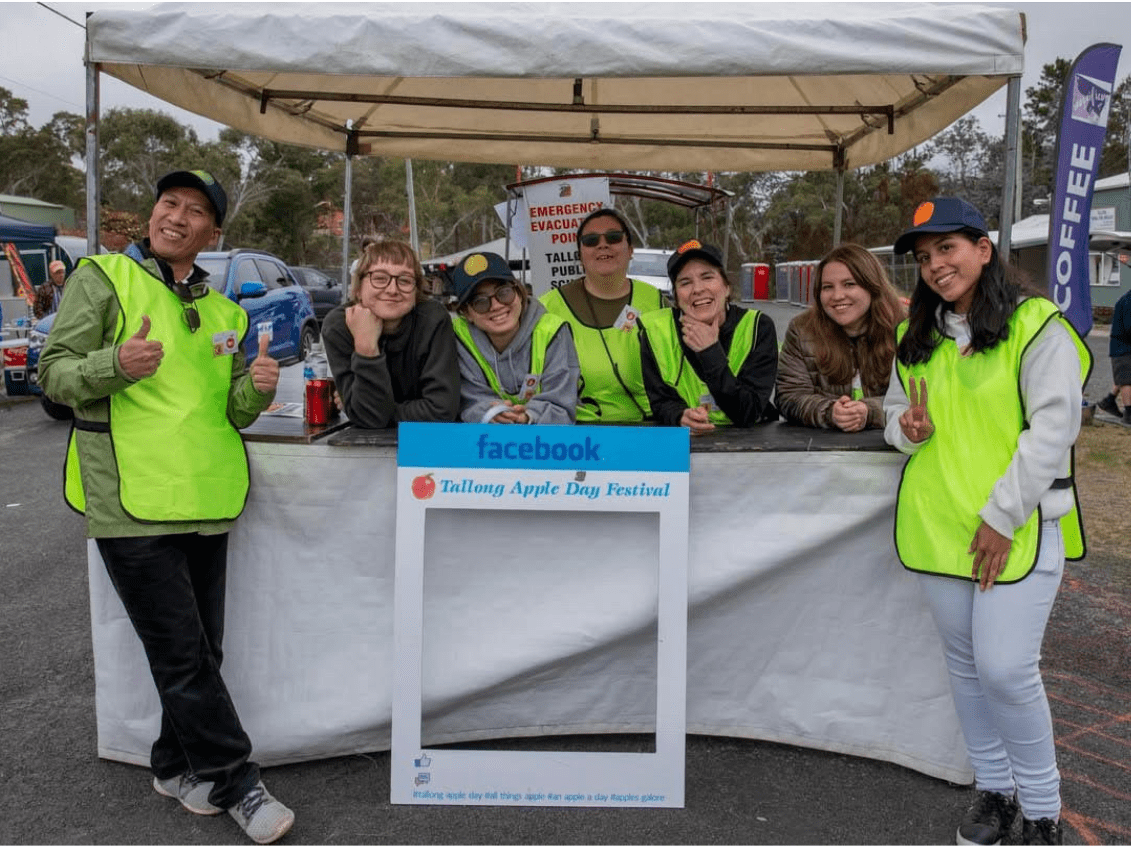
This year, I was fortunate to take part in an IVP project in the beautiful, welcoming community of Tallong, New South Wales, Australia. Together with six other volunteers from across the globe — Vietnam, Laos, Indonesia, Mexico, Russia, Australia, and Germany — we lent a hand at the Tallong Apple Day Festival.


When I told friends, colleagues, and family back home in Germany that I would be travelling halfway around the world to… sell apple pies, they smiled politely and shook their heads. “You’re doing what?!”


And honestly, I could not quite explain it either. Why spend 22 hours on a plane and give up precious vacation days — instead of lounging by a pool, going on safari, or learning to kite surf — just to help at a small-town festival?


Maybe a little story will help answer that.


Tallong, Sunday, September 28, 2025


After a full week of preparation — moving tables and chairs, removing bits of trash from lawns and pathways, setting up tents, sorting and labeling items, hanging exhibits, laminating signs, bagging apples, slicing pies, and nervously checking the weather forecast — the big day finally arrived.


People came from near and far to enjoy the festival: watching pig races and pie-eating contests, admiring vintage cars, cheering on woodcutters and medieval reenactors, listening to live music, and browsing stalls filled with cider, crafts, art, and, of course, apple pies.


From early morning we were rushing all over the place — taking tickets, fastening wristbands, lending a hand wherever needed, and yes, selling apple pies by the dozen.


Then, suddenly, it was over. The crowd dispersed, vendors packed up, and we finally stopped moving long enough to notice how tired — and how happy — we were.


Just then, a local photographer we had met during the setup came over for one last group photo. As he was leaving, he told us how deeply moved he felt seeing people from all over the world working side by side at a small-town festival in rural Australia. He explained that years ago, his daughter had volunteered in South America — and that, somehow, it felt as if something she had given back then had now come full circle to his own community.

Something had quietly returned.


In that moment — amid the packing up, the laughter, the bustle — his words sank in. I think all of us volunteers felt the same quiet emotion. It was a reminder of what a peaceful, connected world could look like: people giving freely, and one day, in some unexpected way, receiving something in return.


That is what volunteering is all about.

That is why we do it.


Thank you to everyone who made it possible for us to be part of this experience.

L to R:  Ou-ee from Laos, Charlotte from Australia, Dao from Vietnam, Helen from Indonesia, Andrea from Germany, Alina from Russia, Melissa from Mexico


SCI 2020 Report

SCI has just released the 2020 SCI annual Report.

https://sci.ngo/about-us/who-we-are/annual-report/